Simple guide

What is NIPT?

NIPT is a blood test in pregnancy. It estimates whether the baby may have a higher chance of some chromosome conditions. It uses only the mother’s blood (no needle into the womb).

Pregnant patient during a prenatal ultrasound exam

NIPT is not ultrasound. It is a blood test. Both are common parts of pregnancy care.

Labeled blood tubes used for laboratory testing

The sample is mother’s blood. The lab looks for DNA pieces from the pregnancy.

What is NIPT?

NIPT means Non-Invasive Prenatal Testing.

  • Blood is taken from the mother’s arm
  • The lab looks at DNA pieces in that blood
  • It checks chance for conditions like Down syndrome
  • It can sometimes also show baby’s sex (if your doctor orders this)

In one sentence

A pregnancy blood test that shows higher or lower chance for some chromosome conditions. Not a final diagnosis.

Who is it for?

Many pregnant people can ask their doctor about NIPT. Your doctor decides if it is right for you.

Often considered if

You want early information. Your doctor suggests screening. You want to talk about next steps with clear results.

Always remember

The test is optional. Talk with your doctor or midwife before you decide.

Parent holding a baby close

Families ask because they care. Your doctor helps you choose what fits your pregnancy.

Is it safe?

Friendly clinician

Yes for pregnancy safety as a blood test. NIPT uses only the mother’s blood. It does not put a needle into the womb. It is different from tests like amniocentesis.

Benefits

Non-invasive

Only a maternal blood draw. No needle into the womb.

Early information

Usually available from about 10 weeks of pregnancy, when enough pregnancy DNA is present.

Clear risk estimate

Helps show higher or lower chance for screened chromosome conditions.

Supports doctor decisions

Results help your clinician decide if more counseling or testing is useful.

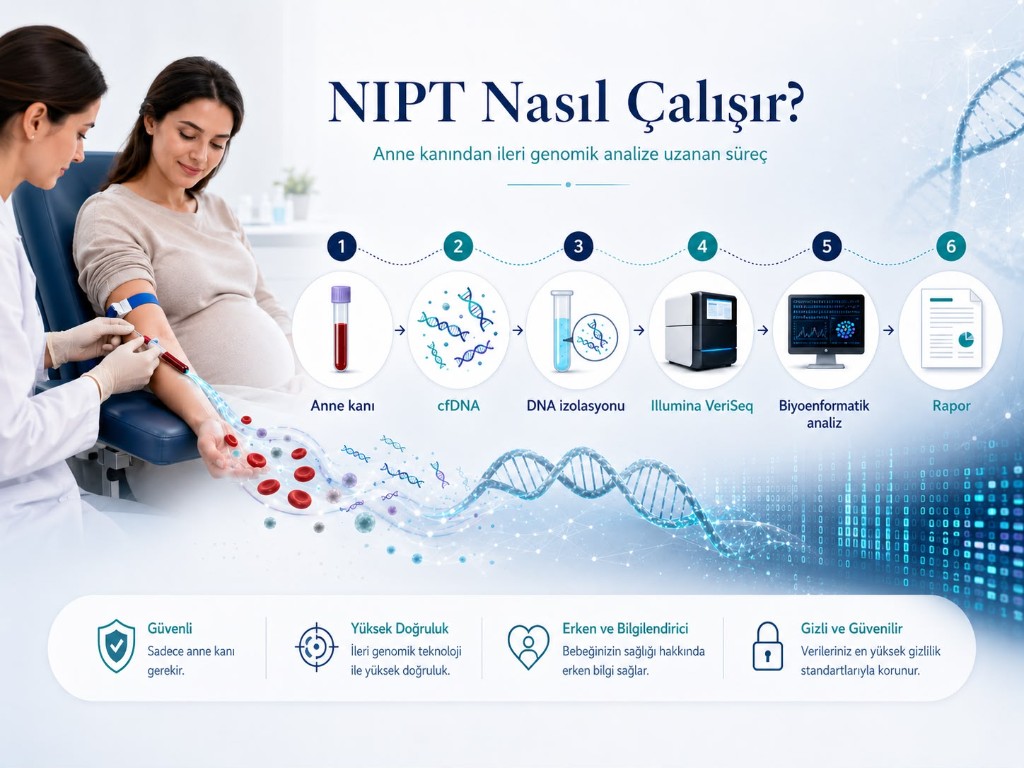
How it works

Doctor talking with a patient

Talk with your doctor

1

Talk

You talk with your doctor.

Blood sample tubes

Blood from the arm

2

Blood

Blood is taken from your arm.

Genomic testing laboratory

Trusted lab checks DNA

3

Lab

A trusted lab checks the DNA.

Doctor reviewing results with a patient

Your doctor explains the report

4

Result with your doctor

Your doctor gets the report and explains it to you in clear words.

Scientist working in a modern genetic testing laboratory

Performance depends on the laboratory panel and clinical context. Your doctor interprets the report.

Test Performance

NIPT is a highly accurate screening method for common trisomies when performed under the right conditions. It is still not a diagnostic test.

  • Designed to estimate chance, not give a final yes/no diagnosis
  • Needs enough pregnancy DNA in the blood (often from about 10 weeks)
  • A higher-chance result may lead to confirmatory testing
  • Exact metrics depend on the partner laboratory and ordered panel

What this means for you

We share pathway details with your clinic. Your doctor explains performance in your specific case.

What do results mean?

Lower chance

The chance of the screened conditions looks lower. Your doctor still guides your pregnancy care.

Higher chance

This does not mean the baby definitely has a condition. Your doctor may suggest another test to be sure.

Exact numbers and lab details are shared by your doctor and our team when your pathway is set.

Doctor explaining a report to a patient

Results are explained by your clinician, not by a website alone.

FAQs

Does NIPT hurt the baby?

No. Only the mother’s blood is taken. There is no needle into the womb.

Is NIPT the same as a final diagnosis?

No. It is a screening test. It shows chance. Only some other tests can confirm.

When can I do the test?

Usually from about 10 weeks of pregnancy, when there is enough pregnancy DNA in the blood. Your doctor tells you the right time.

What should I do next?

Talk with your doctor, or request information from us. We explain the process in clear words.

Still unsure?

Request information. We answer clearly. Then you decide with your doctor.